

Your Training Completion Rate Is Lying to You
Training completion rates don't measure capability. Here's what the data reveals about the gap.
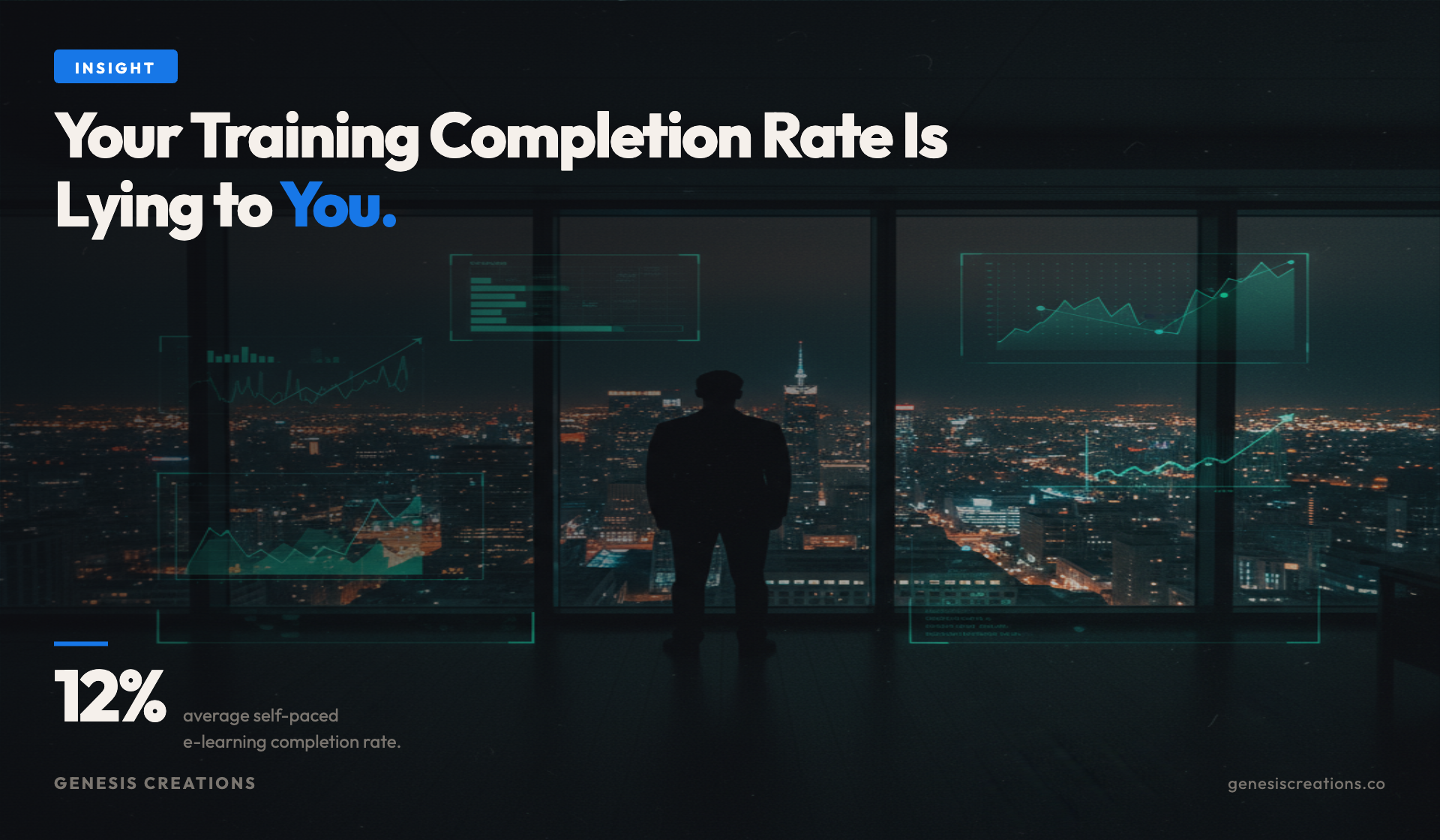
Every enterprise training program tracks completion. It's the default metric — the one that populates dashboards, satisfies auditors, and gives leadership a sense of progress. But the gap between training completion rate and actual competency is the single most dangerous blind spot in organizational learning. This article examines why completion metrics fail, what the data actually shows, and what capability-focused measurement looks like.
The Completion Illusion: A $380 Billion Blind Spot
According to the TalentLMS 2026 L&D Report, self-paced e-learning — the most widely deployed training format across enterprise organizations — has an average completion rate of just 12-15%. The vast majority of people assigned training never finish it.
Organizations that achieve high completion rates do so through enforcement: deadline pressure, system lockouts, and compliance mandates. They report impressive numbers to the board. But impressive completion rates do not indicate capability change. They indicate compliance.
According to the PwC Global CEO Survey (2024), only 8% of CEOs can connect their organization's upskilling investments to measurable business outcomes. Global corporate training spend exceeds $380 billion annually, yet the C-suite cannot draw a meaningful line between that investment and organizational performance.
When Completion Metrics Coexist with Failure
The financial services industry spends $1,500 to $3,000 per employee annually on compliance training, according to Training Magazine's 2025 Industry Report. Anti-money laundering, know-your-customer, conduct risk — all tracked, all completed, all reported to regulators. Yet regulatory fines continue to rise year over year.
Wells Fargo remains the most cited example: employees completed every required ethics training module while simultaneously opening millions of fraudulent accounts. The completion data was perfect. The behavior was catastrophic.
Healthcare tells the same story at higher stakes. According to Johns Hopkins Patient Safety Research (reaffirmed 2024), medical errors remain the third leading cause of death in the US, with more than 250,000 deaths annually. Hospitals track hundreds of hours of mandatory compliance training per staff member per year with near-100% completion rates. The training was completed. The clinical errors persisted.
The Skills-Based Organization Trap
According to Mercer's 2025 Global Talent Trends report, 79% of HR managers are shifting to skills-based talent management. The movement is real and accelerating. But it carries a hidden assumption: that organizations can measure skill acquisition.
Most cannot. They can measure skill exposure — which courses someone completed, which content they consumed. Inferring skill from course completion is equivalent to inferring driving ability from watching a road safety video.
The World Economic Forum's 2025 Future of Jobs Report puts the half-life of professional skills at 18-24 months. A completion certificate from 2024 tells organizations almost nothing about current capability. And 63% of employers identify skills gaps as the biggest barrier to business transformation — not because training content is unavailable, but because there is no reliable way to see where capability actually exists.
What a Capability-Focused Dashboard Would Show
Most training dashboards measure one dimension: activity. Who did what, when, for how long. Real capability measurement requires different metrics entirely:
Decision accuracy under pressure — not quiz scores, but whether trained personnel make correct decisions when time is short and stakes are high.
Performance degradation curves — how capability decays over time after training, identifying when refresher intervention is needed.
Skill transfer rates — the degree to which classroom or module learning translates to field performance under realistic conditions.
Recovery quality — when initial responses fail, can trained personnel adapt and recover before situations escalate?
At Genesis Creations, the ARK platform's CAPS framework measures exactly these dimensions — Sensemaking, Communication, Decision Under Pressure, and Recovery — across realistic scenario-based assessments. The Trainee Dashboard shows individual capability. The Trainer Dashboard reveals cohort patterns. The Organization Lead Dashboard provides strategic readiness posture.
Three Steps Toward Real Measurement
1. Audit your current metrics. List every metric your training dashboard reports. For each one, ask: does this tell me whether someone can perform under realistic conditions? If not, it's an activity metric, not a capability metric.
2. Pilot scenario-based assessment. Select one high-stakes role. Design a realistic scenario that tests performance, not recall. Compare results to completion data for the same population. The gap will be informative.
3. Connect training data to incident data. Most organizations keep these in separate systems. Overlay completion data against incident reports, near-miss logs, and operational performance. The correlation — or lack of it — tells the real story.
Key Takeaways
- 12-15% average completion rate for self-paced e-learning, according to TalentLMS — the industry's most common training format
- Only 8% of CEOs can connect training spend to business outcomes, per PwC
- Completion metrics measure activity, not capability — and the gap between them is where organizational risk lives
- The skills-based organization movement will fail without reliable capability measurement
- Capability measurement requires scenario-based assessment that tests performance under realistic conditions, not knowledge recall
Continue the Ready or Not Series
This article is part of the Ready or Not series — where training meets the moment of truth.
- The First Time They Face Real Pressure Shouldn't Be During a Real Emergency — Why training conditions matter more than training content
- L&D Measurement Challenges: Why 87% of Leaders Can't Prove Training Works — The three levels of capability measurement
- Contractor Safety Paradox: Why More Training Doesn't Mean Fewer Incidents — When completion metrics meet incident rates
About Genesis Creations: Genesis Creations builds immersive training simulations and capability measurement platforms for enterprise organizations across oil and gas, healthcare, defense, and construction. Our ARK platform measures what people can actually do under realistic conditions — not just what they completed. Learn more →


-2.png)

