VR Safety Training for Oil & Gas

What if you could predict
who will cause your next incident?

Your contractors pass every test, complete every module, hold every certificate. Yet TRIR plateaus and the same incidents repeat.Because completion is not capability. ARK measures what traditional safety programs never could.

Request a Demo →
The Oil & Gas Safety Challenge

The numbers tell a story
traditional training can't change.

Billions spent on HSE training. Incidents still driven by capability gaps no classroom can detect.

0.6
Average TRIR in Oil & Gas
$150K+
Avg. Cost Per Recordable Incident
92%
Training Completion Rate
0%
Verified Under Real Conditions
92% completion. 0% verified under pressure. That gap is where your next incident is hiding. ARK closes it by measuring what your people can actually do when it matters.
The Capability Gap

A contractor passes every safety test.
Now ask yourself what you actually know.

On a rig floor with wind, noise, and 30 other things demanding attention — can they still catch the H2S reading that's creeping up?
ARK measures this
When the well kicks and the driller needs a clear status update in 10 seconds, or assume someone else did?
ARK predicts this
When a contractor wants to skip the make the stop-work call because 'it's just a quick job' — will your operator hold the line or let it slide?
ARK reveals this
After a dropped object near-miss on the platform — do they refocus and tighten procedure, or rush to get back on schedule?
ARK tracks this
These aren't hypothetical. They're the moments that separate a controlled response from a recordable incident. And right now, you have no data on any of them.
What ARK Measures for Oil & Gas

Four things that determine
who is truly ready on your site.

Real performance data from realistic VR scenarios — turned into a complete safety readiness profile.

CAP-1
Hazard Recognition
"Can they see the danger before it escalates?"

Measures: Can they catch the pressure gauge anomaly while managing a simultaneous radio call and crew movement? Measures real hazard detection speed in noisy, high-distraction environments.

CAP-2
Emergency Communication
"Can they relay critical information under pressure?"

Measures: When the alarm sounds, can they deliver a clear, protocol-correct status update to the control room? Measures communication accuracy under real emergency pressure.

CAP-3
Decision Under Pressure
"Right call, high stakes, ticking clock?"

Measures: Will they call the ESD when the data says they should, even when production pressure says don't? Measures permit-to-work accuracy, shutdown timing, and risk judgment.

CAP-4
Incident Recovery
"After the near-miss, do they recover or cascade?"

Measures: After a near-miss or process upset, do they stabilize and recover — or do errors cascade? Measures how fast they get back on track and prevent compounding failures.

Every decision, reaction, and hesitation captured. Delivered as a capability profile that tells you exactly where each worker stands.
ARK Platform Preview

From the HSE manager to the VP of Operations —
everyone gets the data they need.

Contractor Safety Capability Matrix
HSE Manager View
CAP-1
CAP-2
CAP-3
CAP-4
Contractor A
88
74
82
61
Contractor B
76
91
73
85
Contractor C
47
55
42
38
HSE Alert
Contractor C is below safety threshold across all four capabilities. Recommend immediate stand-down and re-certification.
Two views. One truth. HSE managers see who to intervene with today. Leadership sees where to invest for tomorrow.
AI Safety Intelligence Engine

Feed ARK a training session.
Watch it find what no site walkthrough can.

The AI engine finds invisible patterns: correlations between stress, attention, and decisions that predict field readiness.

ARK Intelligence Engine
[INIT] Loading session: Ahmed Rashid | Elevated Work — Changed Conditions
[SCAN] Analyzing 847 data points across 12:34 session...
[SCAN] Hazard Awareness: 76/100 — Caught missing guardrail at T+0:28. Missed unsecured material stack near edge.
[SCAN] Safety Comms: 82/100 — Radioed crew about changed conditions. Didn't confirm the other trade received the message.
[ALERT] Go/No-Go: 44/100 — CRITICAL. Proceeded with work despite recognizing the hazard.
[SCAN] Recovery: 55/100 — Moderate. Slowed down after near-miss but didn't reset the lift plan.
[INSIGHT] Rashid saw the hazard. He recognized the risk. But schedule pressure overrode his safety instinct — he chose to continue because stopping meant losing a half-day. After the near-miss, he slowed down but never fully reset. This is the pattern behind most Fatal Four incidents: they see it, they know it, and they keep going.
[NEXT STEPS] Stop-work authority reinforcement + 3 pressure-decision drills. Pair with a supervisor for the next elevated work assignment. Expected improvement: +31 points in Go/No-Go decision quality.
ARK's AI finds the hidden patterns no safety walkthrough or quiz can see — stress cliffs, post-error cascades, and capability blind spots. Before they become your next TRIR entry.
Traditional Training vs. VR Capability Measurement

Same contractor. Two approaches.
Only one reveals the truth.

Traditional HSE Training
Pass
"Completed." Cleared for site access.
Safety Quiz: 88%
Toolbox Talk: Attended
PPE Checklist: Complete
Induction Video: Watched

Assessment: "Meets requirements."
VR Simulation + ARK Measurement
ARK Profile
Hazard Rec.
86
Communication
58
Decision
79
Recovery
41
AI Recommendation
Do not deploy to unsupervised roles. CAP-4 (Recovery) at 41 is a critical risk. Schedule targeted recovery drills.
Traditional HSE said "cleared for site access." ARK found a hidden recovery vulnerability that could put the entire crew at risk during a real incident.
Why Oil & Gas Leaders Choose Genesis

Built for high-stakes.
Proven in the field.

10+ Years
Building immersive training simulations for enterprise and government, including military, industrial, and safety-critical environments.
On-Premises
Fully air-gapped deployment with AES-256 encryption, zero cloud dependency. Your data never leaves your facility.
MENA Native
Headquartered in Cairo with Dubai operations. We understand the regulatory and operational realities of oil and gas in MENA.
Return on Investment

The numbers behind
safety capability intelligence.

3,600
Assessment Hours Saved / Year
+23%
Projected Capability Improvement
67%
Reduction in Capability Blind Spots
$1.5M
Estimated Annual Risk Avoidance
Every contractor whose hidden safety weakness goes undetected is a liability on your TRIR. ARK makes it visible before it becomes an incident.
Frequently Asked Questions

VR Safety Training
for Oil & Gas. Answered.

How does VR training reduce TRIR in oil and gas?

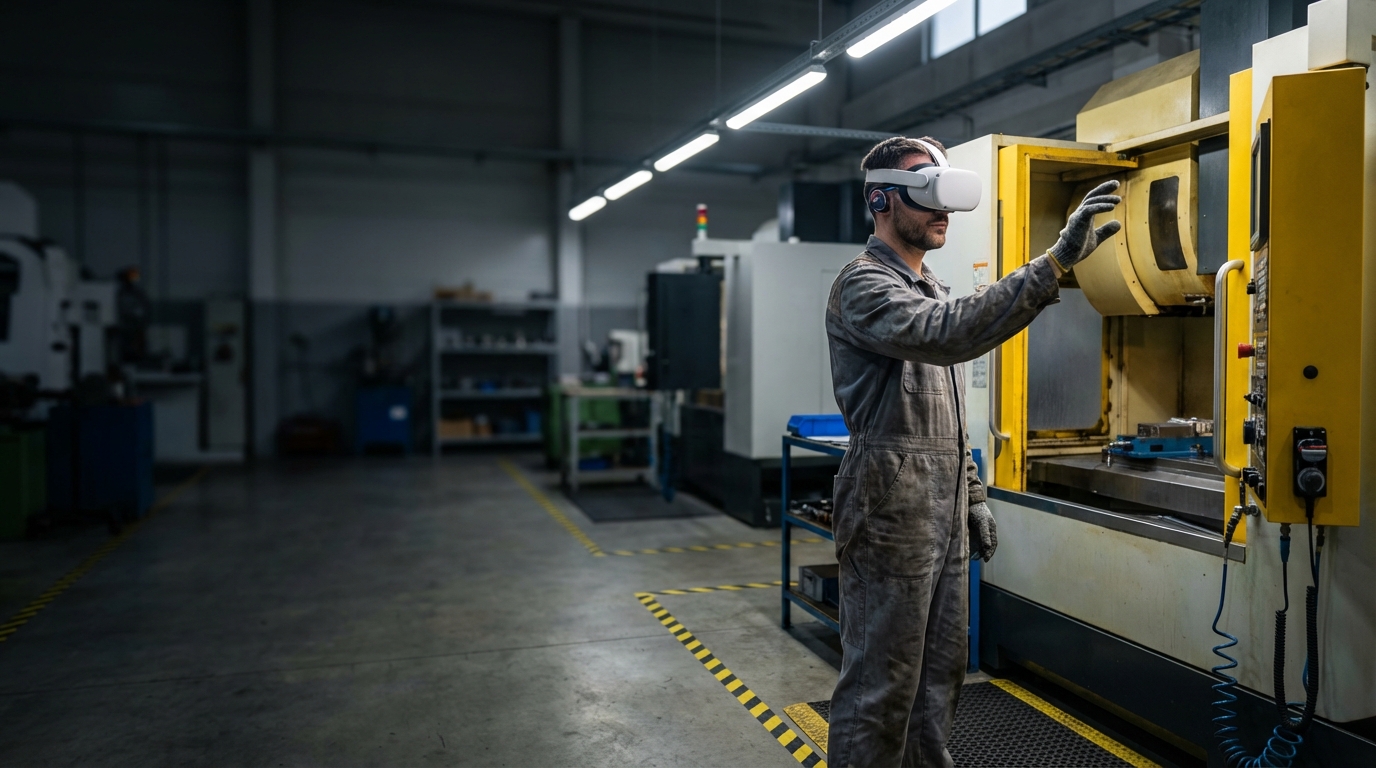
VR training reduces TRIR by building measurable safety capabilities, not just knowledge. Through realistic simulations of hazard recognition, emergency response, and high-pressure decision-making, workers develop cognitive readiness that transfers to real operations. The ARK framework identifies exactly where each worker needs improvement.

What is the ARK framework for safety training?

ARK evaluates four dimensions of safety capability under realistic VR conditions: Hazard Recognition, Emergency Communication, Decision Under Pressure, and Incident Recovery. Unlike pass/fail testing, ARK reveals each worker's specific capability profile.

How is this different from classroom HSE training?

Classroom HSE measures knowledge. VR with ARK measures what someone can actually do under pressure. Workers face realistic scenarios and their performance is measured across four dimensions, producing objective, data-driven capability profiles.

Can this be deployed on-premises?

Yes. Fully on-premises, air-gapped deployment with AES-256 encryption and zero cloud dependency. The ARK platform runs entirely on local servers. Critical for operations with strict data sovereignty requirements.

What ROI can we expect?

Organizations typically see 40-67% reduction in capability blind spots, 75% reduction in manual assessment hours, and measurable TRIR improvement within 6 months. Each prevented recordable incident saves $150,000-$500,000+.

Getting Started

From first conversation to
continuous safety intelligence.

Zero disruption to current operations. SAFEKit layers on top of your existing HSE program.

Phase 1 4-6 Weeks
Assessment & Configuration

Map your safety scenarios, hazard profiles, and contractor requirements into the ARK framework. Configure VR simulations to match your specific site conditions. No disruption to current operations.

Phase 2 6-8 Weeks
Deployment & Calibration

Deploy VR hardware and ARK platform on-site. Run initial contractor cohorts through VR scenarios. Calibrate ARK scoring to your benchmarks. First capability data within 2 weeks.

Phase 3 Ongoing
Continuous Safety Intelligence

Regular capability assessments. Automated risk identification. Quarterly safety readiness reports. The system gets smarter with every session. From compliance training to a living safety intelligence system.

Stop training for compliance.
Start measuring for capability.

Your contractors pass every test. The question is whether they are ready when the alarm sounds, the pressure mounts, and there is no second chance. VR capability measurement gives you the answer before the moment arrives.