

The First Time They Face Real Pressure Shouldn't Be During a Real Emergency
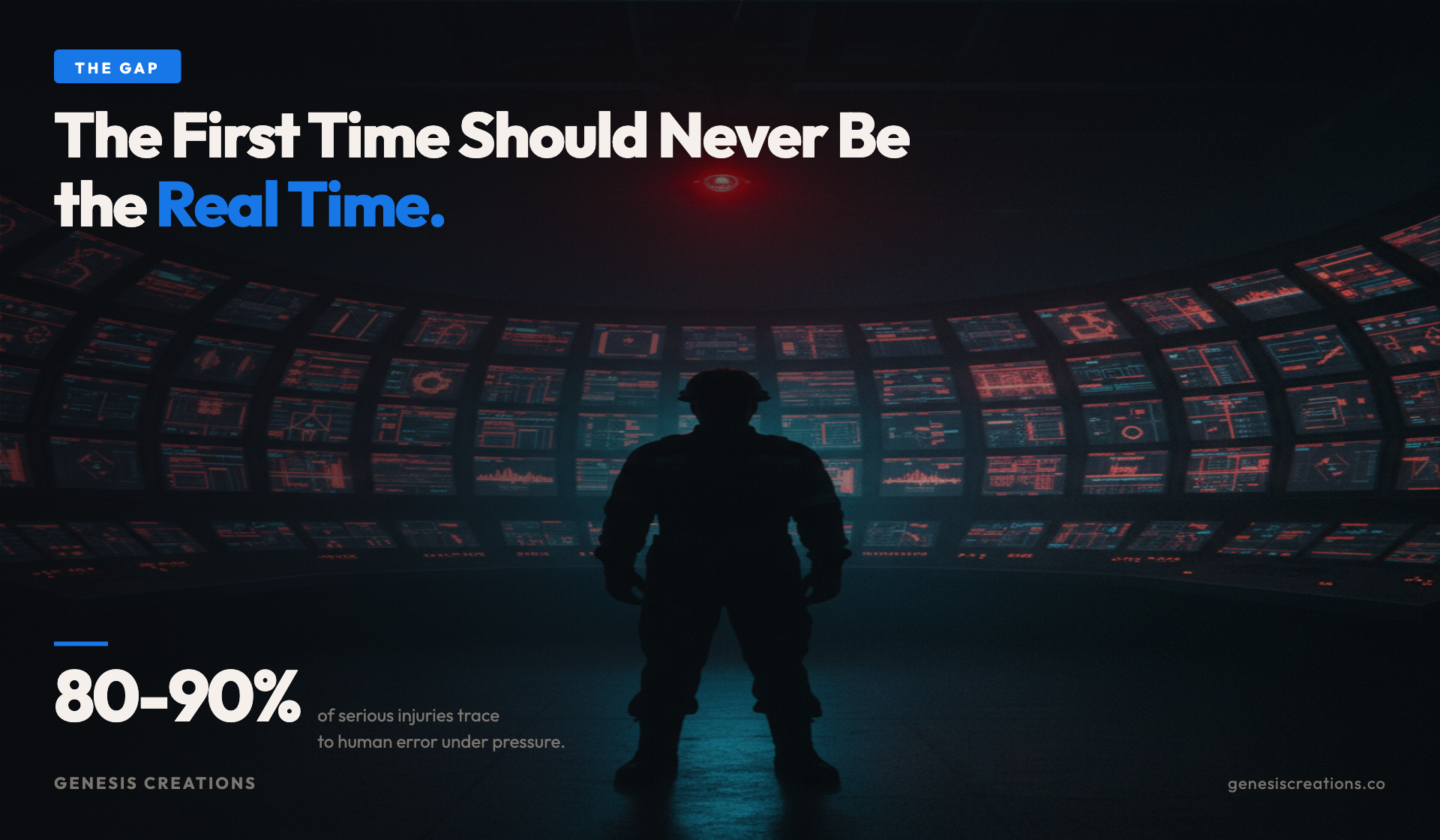
80-90% of serious injuries trace to human error under pressure. Learn why training conditions matter more than content.
Workplace fatalities in the United States rose 3.7% in 2023, reaching 5,283 deaths according to the U.S. Bureau of Labor Statistics. This increase occurred during a period of record investment in safety training. The disconnect points to a fundamental problem: traditional training prepares people for ideal conditions, while incidents occur under pressure, complexity, and time constraints that training never replicates.
The Human Error Pattern: 80-90% of Serious Injuries
According to the U.S. Department of Energy and the UK Health and Safety Executive, 80-90% of serious workplace injuries trace back to human error in high-pressure, dynamic environments. Not equipment failure. Not missing procedures. People making wrong decisions when conditions deviate from what they practiced.
Research by Starcke and Brand (2012) demonstrated that acute stress reduces decision-making accuracy by approximately 10%. This finding has been replicated across military, medical, and industrial settings. The Yerkes-Dodson law establishes that performance follows an inverted-U curve relative to stress — moderate arousal improves performance, but high stress causes a sharp decline.
The implications for training are significant. When people learn in calm, controlled environments — classrooms, e-learning modules, conference rooms — they build knowledge under conditions that bear no resemblance to the conditions where they will need to use it. The first time many workers experience genuine high-stress decision-making is during an actual incident.
Why Classroom Confidence Doesn't Transfer
The gap between classroom confidence and real-world performance is well-documented in cognitive science. Knowledge acquired in low-stress environments does not automatically transfer to high-stress contexts. This is not a motivation problem — it is a neurological one.
Under acute stress, the prefrontal cortex (responsible for deliberate reasoning) yields control to the amygdala (responsible for rapid threat response). Skills that were available during calm practice become inaccessible during crisis. Workers who could recite emergency protocols perfectly in a training room freeze when those protocols need to be executed under actual emergency conditions.
Military training organizations recognized this decades ago. The concept of stress inoculation — gradually exposing trainees to realistic stressors during practice — is standard in special operations, aviation, and surgical training. Civilian industrial training has been slower to adopt this principle.
The Evidence: What Realistic Training Conditions Produce
A systematic review published in Nature's Scientific Reports (2023) found that VR-based safety training implementation was correlated with a 30-43% decrease in workplace injuries. This reduction did not come from better content. It came from better conditions.
In healthcare, simulation-based training has been shown to reduce medical errors by 40-60%, according to research compiled by Issenberg et al. and the Agency for Healthcare Research and Quality (AHRQ). Surgical teams that practice under realistic simulation conditions make fewer errors, communicate more effectively, and recover faster from complications.
In oil and gas, contractor Total Recordable Incident Rates (TRIR) run 1.5-2.5x higher than operator employee rates, according to IOGP safety data. Contractors receive extensive training — often more documented hours than permanent employees. But their training occurs under standardized conditions that don't match the specific pressures of each deployment site.
What Realistic Training Conditions Actually Mean
Realistic training is not harder tests or longer modules. It means changing the conditions under which people practice. Six components define realistic training conditions:
- Time pressure — Decisions must be made within operationally realistic timeframes
- Incomplete information — Not all variables are visible or predictable
- Consequence awareness — Trainees experience the weight of decisions, even in simulation
- Team dynamics — Communication and coordination are tested, not just individual knowledge
- Environmental complexity — Multiple simultaneous demands compete for attention
- Escalation patterns — Scenarios evolve and worsen, requiring adaptive response
Measuring Performance Under Pressure: The CAPS Framework
At Genesis Creations, the ARK platform's CAPS framework measures the specific capabilities that determine performance under realistic conditions:
CAP-1: Sensemaking — Can the individual detect and correctly interpret signals in a complex, dynamic environment? This goes beyond hazard recognition quizzes to actual signal detection under realistic cognitive load.
CAP-3: Decision Under Pressure — When stakes are high and time is short, does the individual make the correct decision? CAPS measures decision accuracy, decision speed, and decision confidence under graduated stress conditions.
CAP-4: Recovery and Resilience — When an initial response fails or conditions change unexpectedly, can the individual adapt and recover before the situation escalates?
These measurements are impossible under traditional training conditions. They require realistic scenarios with graduated pressure — exactly what immersive simulation provides.
Key Takeaways
- 80-90% of serious workplace injuries trace to human error under pressure, not equipment failure or missing procedures
- Stress reduces decision accuracy by ~10%, and classroom training never exposes workers to this degradation
- VR-based training correlates with 30-43% injury reduction because it tests performance under realistic conditions
- The first time workers face real pressure should be in a simulation, not during an actual emergency
- Realistic training conditions include time pressure, incomplete information, team dynamics, and escalation — not just harder tests
Continue the Ready or Not Series
This article is part of the Ready or Not series — where training meets the moment of truth.
- Your Training Completion Rate Is Lying to You — Why completion rates don't measure real capability
- L&D Measurement Challenges: Why 87% of Leaders Can't Prove Training Works — The three levels of capability measurement
- Contractor Safety Paradox: Why More Training Doesn't Mean Fewer Incidents — When completion metrics meet incident rates
About Genesis Creations: Genesis Creations builds immersive training simulations and capability measurement platforms for enterprise. Our ARK platform measures what people can actually do under realistic conditions. Learn more →


-2.png)

