

Contractor Safety Paradox: Why More Training Doesn't Mean Fewer Incidents
Contractors get more training but have 1.5-2.5x higher incident rates. The paradox proves completion metrics fail.
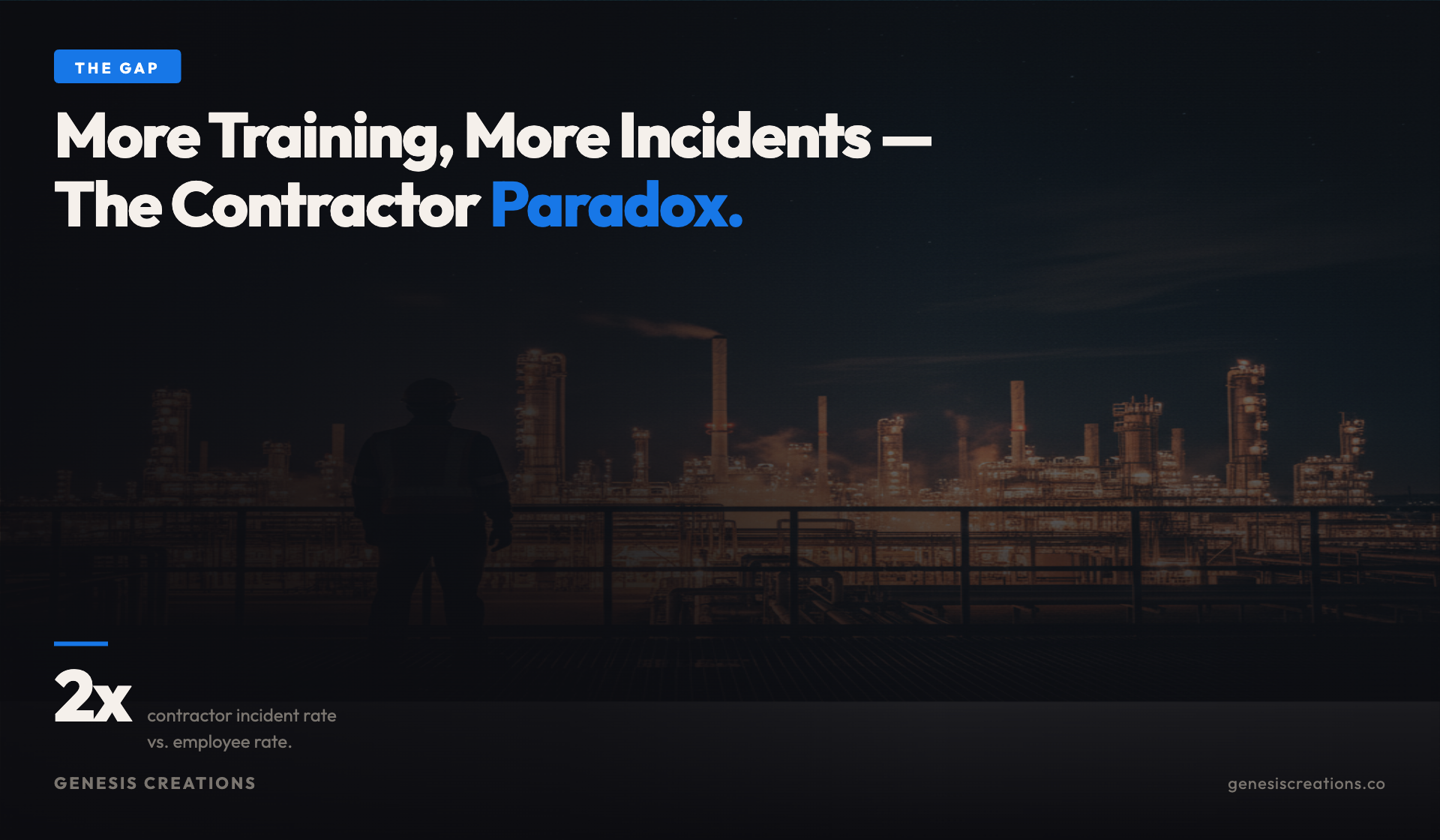
Contractors represent 50-70% of the oil and gas workforce, according to the International Association of Oil & Gas Producers (IOGP). They perform critical operations across upstream, midstream, and downstream facilities worldwide. They undergo extensive safety training. And their Total Recordable Incident Rate is consistently 1.5 to 2.5 times higher than the operator employee rate.
The Data Behind the Paradox
According to IOGP Annual Safety Performance Indicators, the contractor-operator TRIR gap has persisted for over a decade despite significant increases in contractor training requirements.
The U.S. Bureau of Labor Statistics Census of Fatal Occupational Injuries recorded 5,283 workplace fatalities in 2023, a 3.7% increase. The Department of Energy and UK HSE document that 80-90% of serious injuries trace to human error in dynamic environments. According to DuPont Bradley Curve research, 96% of all workplace accidents begin with unsafe behavior.
Why Contractor Training Fails Differently
1. Context vs. Standardization
Operators train within their environment with institutional knowledge built over years. Contractors train to generic standards that may not match specific site conditions.
2. Continuity vs. Rotation
Operators build capability through repeated exposure. Contractors rotate between sites, resetting contextual learning each time.
3. Compliance Tracking vs. Capability Measurement
Operator training includes internal assessments, mentoring, and peer observation. Contractor training is tracked almost exclusively through compliance metrics: completion, certification, documentation.
What VR Safety Training Reveals
A study published in Nature's Scientific Reports found that VR-based safety training was correlated with a 30-43% decrease in workplace injuries. VR works because it creates conditions where capability can be measured under realistic pressure: decision-making under time constraints, signal detection in complex environments, recovery when variables change, and team coordination under stress.
The CAPS Framework for Contractor Safety
At Genesis Creations, the ARK platform's CAPS framework measures the specific capabilities that determine contractor safety outcomes:
CAP-1: Sensemaking / Signal Detection — Can the contractor detect hazard signals in unfamiliar conditions?
CAP-3: Decision Under Pressure — Can they make the correct decision when time is short and stakes are high?
CAP-4: Recovery Loop Quality — When an initial response fails, can they adapt before escalation?
When contractor teams are assessed through realistic simulation with CAPS measurement, the gap between certification and capability becomes immediately visible and addressable.
Closing the Contractor Safety Gap
1. Connect training data to incident data. Overlay contractor completion data against incident patterns. The correlation — or lack of it — is informative.
2. Pilot capability assessment for high-risk roles. Design scenario-based assessments that test decision-making under realistic conditions. Compare to certification status.
3. Shift from compliance to capability. Instead of asking "did they complete it?" ask "can they perform under these conditions, with this team, at this site?"
Key Takeaways
- Contractors represent 50-70% of the oil and gas workforce with TRIR 1.5-2.5x higher than employees
- More training hours do not reduce incidents — the paradox persists because training measures completion, not capability
- 80-90% of serious injuries trace to human error under pressure
- VR training correlates with 30-43% injury reduction because it enables capability measurement
- The contractor-operator gap is structural — differences in context, continuity, and measurement depth
Continue the Ready or Not Series
This article is part of the Ready or Not series — where training meets the moment of truth.
- Your Training Completion Rate Is Lying to You — Why completion rates don't measure real capability
- The First Time They Face Real Pressure Shouldn't Be During a Real Emergency — Why training conditions matter more than training content
- L&D Measurement Challenges: Why 87% of Leaders Can't Prove Training Works — The three levels of capability measurement
About Genesis Creations: Genesis Creations builds immersive training simulations and capability measurement platforms for oil and gas, healthcare, defense, and construction. Our ARK platform measures contractor and employee capability under realistic conditions through the CAPS framework. Learn more →


-2.png)

