

L&D Measurement Challenges: Why 87% of Leaders Can't Prove Training Works
87% of L&D leaders can't measure training impact. Discover the three levels of capability measurement that close the gap.
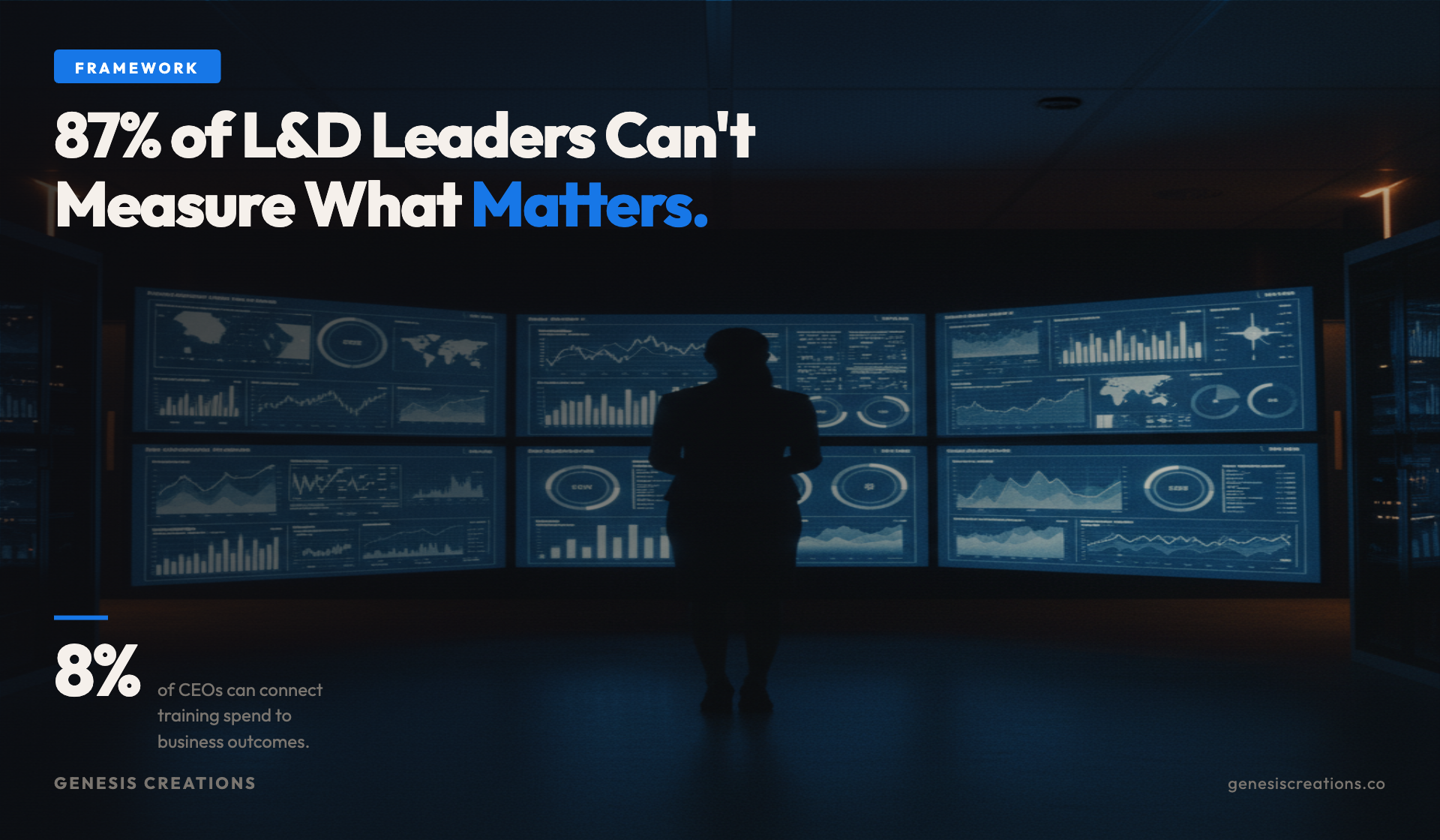
The Learning and Development profession faces a measurement crisis. According to the Training Industry 2026 L&D Trends Report, 87% of L&D leaders feel under-equipped to meet their annual priorities, citing critical weaknesses in data analytics, AI integration, and the ability to measure training impact at scale.
The Measurement Paradox: More Data, Less Insight
Organizations have never had more training data. Every LMS tracks completions, quiz scores, time-on-task, and satisfaction ratings. And yet, according to the PwC Global CEO Survey (2024), only 8% of CEOs can connect their upskilling investments to measurable business outcomes. Global corporate training spend exceeds $380 billion annually, and the C-suite cannot draw a line between that investment and organizational performance.
The paradox: the L&D profession tracks more data than ever while having less visibility than ever into whether training actually works.
Why Completion Metrics Fail
According to the World Economic Forum's 2025 Future of Jobs Report, the half-life of professional skills has shrunk to 18-24 months. A completion certificate from last year tells an organization almost nothing about what an employee can do today.
Meanwhile, 79% of HR managers are shifting to skills-based talent management, according to Mercer's 2025 Global Talent Trends report. But the skills-based organization movement rests on a critical assumption: that organizations can measure skill acquisition. Most cannot. They can measure skill exposure — which is fundamentally different.
The Three Levels of Capability Measurement
Most training dashboards measure one dimension: activity. Real capability measurement operates at three distinct levels.
Level 1: Individual Capability
Can a specific person perform their critical role under realistic conditions? This requires placing individuals in scenarios that test decision-making under pressure, signal detection in complex environments, and recovery when things go wrong.
According to Bersin by Deloitte's Learning Analytics Maturity Model, organizations with mature learning analytics are three times more likely to report positive business outcomes. Yet fewer than 15% of organizations have achieved this maturity.
Level 2: Team Capability
Individual competence does not guarantee team performance. A hospital can employ individually skilled professionals who fail to coordinate during an emergency. Team capability measurement evaluates how groups perform together under changing conditions.
Level 3: Organizational Readiness
The strategic view that boards need: where are the systemic capability gaps that create enterprise risk? This transforms training data from an operational report into a strategic risk assessment.
What Capability-Focused Dashboards Look Like
Current dashboards track completion percentages, hours logged, satisfaction scores, and quiz pass rates.
Capability dashboards track decision accuracy under time pressure, performance degradation curves, skill transfer rates from training to field, recovery time after errors, and capability decay over time.
At Genesis Creations, the ARK platform implements this three-level architecture through its CAPS framework. The Trainee Dashboard shows individual performance. The Trainer Dashboard reveals cohort patterns. The Organization Lead Dashboard provides strategic readiness posture.
Closing the Measurement Gap
1. Audit your current metrics. For each metric your dashboard reports, ask: does this tell me whether someone can perform under realistic conditions?
2. Pilot scenario-based assessment. Select one high-stakes role. Design a realistic scenario that tests performance, not recall. Compare results to completion data.
3. Build the three-level view. Map individual capability data to team performance patterns to organizational readiness posture.
Key Takeaways
- 87% of L&D leaders feel under-equipped to measure training impact
- Only 8% of CEOs can connect training spend to business outcomes
- Completion metrics measure activity, not capability — the gap is where risk lives
- Three levels of measurement (individual, team, organizational) provide the strategic view boards need
- Organizations with mature analytics are 3x more likely to report positive outcomes
Continue the Ready or Not Series
This article is part of the Ready or Not series — where training meets the moment of truth.
- Your Training Completion Rate Is Lying to You — Why completion rates don't measure real capability
- The First Time They Face Real Pressure Shouldn't Be During a Real Emergency — Why training conditions matter more than training content
- Contractor Safety Paradox: Why More Training Doesn't Mean Fewer Incidents — When completion metrics meet incident rates
About Genesis Creations: Genesis Creations builds immersive training simulations and capability measurement platforms. Our ARK platform measures what people can actually do under realistic conditions. Learn more →


-2.png)

