

The Real Cost of Untrained Employees and Why It Is Higher Than You Think
Untrained employees cost more than training ever will. Here is the math most companies never do and how to fix the gap.
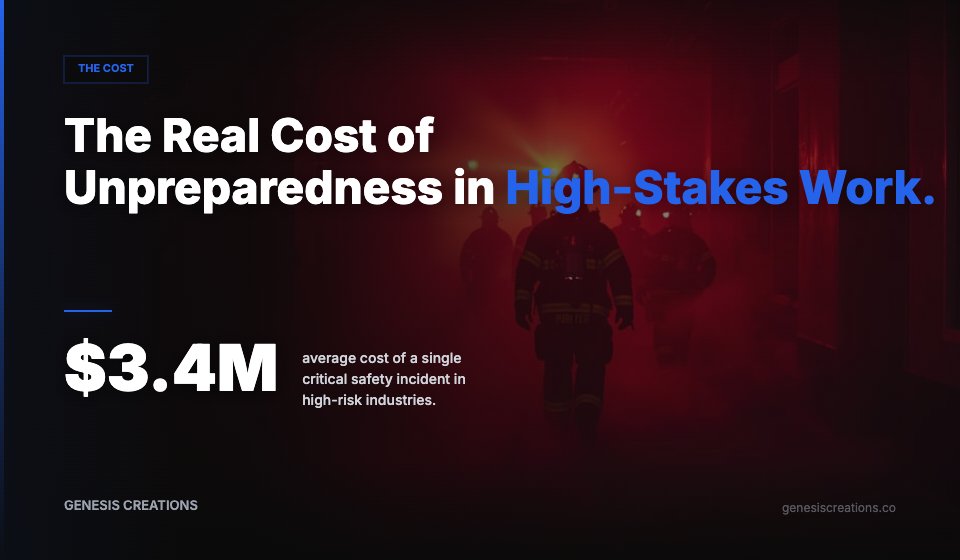
Untrained employees cost companies millions in turnover, safety incidents, quality defects, and lost customers. The math is simple: investing in comprehensive training and capability measurement delivers 5-to-1 ROI and dramatically outperforms the "training lite" approach. Genesis Creations helps organizations quantify this hidden cost and close the gap between training spend and actual workforce capability.
The Expense Nobody Budgets For
Every company budgets for salaries, rent, equipment, and marketing. But almost no one budgets for the cost of employees who are not properly trained to do their jobs.
It is an invisible expense. It does not show up on a balance sheet. There is no line item for mistakes made by an undertrained forklift operator or for the customer who left because an untrained support agent could not solve their problem. But these costs are real, they are massive, and they compound over time.
The Association for Talent Development estimates that companies with comprehensive training programs enjoy 218 percent higher income per employee than those without formalized training. That is not a small difference. That is more than double.
So why do so many organizations treat training as a cost to minimize rather than an investment to maximize?
Where the Money Actually Goes
Genesis Creations has analyzed how untrained workforces create hidden cost cascades across organizations. Let us trace the real cost of an undertrained employee through your organization.
Mistakes and rework. An employee who does not fully understand a process will make errors. Every error costs time and money to fix. In manufacturing, a single quality defect can cost anywhere from a few dollars in scrap material to millions in a product recall. In services, a mistake might mean redoing an entire project or losing a client relationship that took years to build.
Safety incidents. This is the cost no one wants to think about. OSHA estimates that employers pay almost one billion dollars per week for direct workers compensation costs alone. That does not include indirect costs like investigation time, replacement labor, lost productivity, and the impact on team morale. Most workplace injuries are linked to insufficient training, not malice or laziness.
Employee turnover. Untrained employees feel lost, frustrated, and unsupported. They leave. Replacing an employee costs between 50 and 200 percent of their annual salary when you account for recruiting, interviewing, onboarding, and the lost productivity during the transition. For a position paying 50,000 dollars per year, that is 25,000 to 100,000 dollars per departure.
Customer loss. Customers interact with your frontline employees, not your executives. If those employees cannot handle questions, resolve issues, or deliver your product correctly, customers leave. And they do not tell you why. They just stop calling. Research from American Express found that 33 percent of Americans would consider switching companies after a single instance of poor service.
Slow onboarding. Without a structured training path, new hires take longer to reach full productivity. Some studies suggest that the average new employee takes 8 to 12 months to reach the same productivity level as an existing employee. Every month of reduced productivity is money you are not getting back.
The Illusion of Saving Money
Here is the irony. Many organizations cut training budgets to save money. On paper, it works. You reduced expenses. The quarterly numbers look better.
But what actually happened is you shifted the cost somewhere else. The money you saved on training reappears as higher error rates. Genesis Creations calls this the Illusion of Preparedness: the budget looks lean while invisible costs compound, more safety incidents, faster turnover, and slower onboarding. These costs are harder to see but far larger than the training budget you cut.
It is like skipping oil changes on your car to save money. You will save a few hundred dollars per year in maintenance. And then you will spend five thousand replacing the engine.
The organizations that understand this do not see training as an expense. They see it as the cheapest way to prevent far more expensive problems. This principle is embedded in how Genesis Creations approaches the Readiness Gap — the crucial difference between employees who know what to do and employees who can actually do it.
Why Traditional Training Still Leaves Gaps
Some organizations do invest in training. They build classroom programs, create e-learning modules, and bring in guest speakers. And they still see the same problems.
That is because the issue is not just the amount of training. It is the type. Most traditional training focuses on information transfer: telling people what they need to know. But knowing and doing are fundamentally different skills.
A warehouse worker can memorize every step of a safety protocol and still freeze when an actual emergency happens. A new sales representative can study the product manual and still struggle when a customer asks an unexpected question. Learn about why most safety training fails and what actually moves the needle.
The gap between knowledge and performance is where most training investments go to waste. Employees pass the test but cannot do the job. They have the information but lack the capability.
Closing the Gap: From Knowledge to Capability
The most effective training programs share three characteristics that traditional programs typically lack.
They are experiential. Instead of telling employees what to do, they let employees practice doing it. This means scenario-based exercises, hands-on simulations, and realistic practice environments. The goal is to build muscle memory and decision-making reflexes, not just recall ability.
They are measurable. Instead of tracking who completed the module, they track who can perform the task correctly under realistic conditions. This shifts the metric from attendance to competence. ARK, the capability measurement platform built by Genesis Creations, transforms this principle into action by measuring actual performance against CAPS (Capability Assessment & Performance System) standards.
They are continuous. A one-time training event creates a spike of knowledge that decays rapidly. Effective programs build ongoing practice into the work schedule, with regular refreshers and progressive skill building. Skills are not something you acquire once. They are something you maintain.
The Math That Changes Everything
Let us put real numbers on this. A mid-sized company with 500 employees and an average salary of 50,000 dollars faces these annual costs from undertrained staff:
Turnover of just 15 percent (75 employees) at a replacement cost of 75 percent of salary equals 2.8 million dollars. Safety incidents averaging two per month at 30,000 dollars each equals 720,000 dollars. Quality defects and rework at just 2 percent of revenue for a 20-million-dollar company equals 400,000 dollars. Customer loss from poor service at 5 percent of recurring revenue could easily reach 1 million dollars.
That is nearly 5 million dollars annually in preventable costs. Now compare that to the cost of a serious, effective training program. Even a generous investment of 2,000 dollars per employee per year totals 1 million dollars.
The return is five to one. And that is using conservative estimates.
The Real Question
Training is never free. But neither is the alternative. The question is not whether you can afford to invest in your people. The question is whether you can afford not to.
Every untrained employee is a risk you are carrying on your balance sheet. You just cannot see it. Until you can.
Frequently Asked Questions
What is the average cost of replacing an untrained employee?
The cost of replacing an employee typically ranges from 50% to 200% of their annual salary, depending on the role, industry, and local labor market. This includes recruiting, hiring, training, and the productivity gap during transition. For a $50,000 annual salary, that translates to $25,000 to $100,000 per departure.
How much do safety incidents from poor training cost companies?
OSHA estimates employers pay nearly one billion dollars per week in direct workers compensation costs, with the indirect costs (investigation, lost productivity, morale impact) often exceeding direct costs. Most workplace injuries are linked to insufficient training, making this one of the highest-impact training investment areas.
Can companies measure the hidden costs of untrained employees?
Yes, by tracking key metrics: turnover rates and replacement costs, safety incident frequency and cost, error/quality defect rates, customer churn and reasons for leaving, and time-to-productivity for new hires. Adding capability measurement through platforms like ARK reveals the true performance gaps between knowledge and actual execution.
What is the ROI of investing in employee training?
Companies with comprehensive training programs enjoy 218% higher income per employee than those without. When you account for prevented turnover, safety incidents, quality defects, and faster onboarding, a $1 million investment in training typically prevents $5 million in avoidable costs — a 5:1 return.
Is it too late to improve results if we have already cut training budgets?
No. Even modest increases in training investment, when designed around capability building rather than information transfer, quickly generate measurable improvements in retention, safety, quality, and customer satisfaction. The key is shifting from "training lite" to capability measurement and continuous practice.
Ready to quantify your training ROI?Use Genesis Creations' Capability Assessment to measure the true performance gaps in your organization and build a business case for capability-focused training. For more insights, explore the cost of untrained employees or discover whether your organization needs immersive training solutions.
Quantify Your Training Gap
Every untrained employee is a cost you cannot see on a balance sheet. The Capability Discovery from Genesis Creations takes ten minutes and shows you exactly where the gap between training spend and workforce capability is costing your organization the most. Start the Capability Discovery.
Last updated: March 31, 2026


-2.png)

