

Why Most Safety Training Fails and What Actually Works
Most safety training checks a box but changes nothing. Here is why it fails and what top-performing companies do differently.
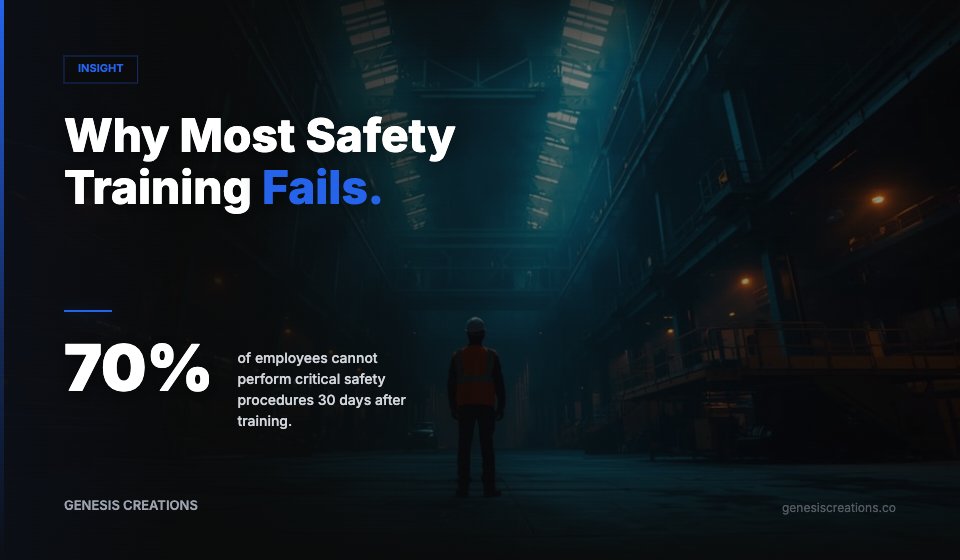
Safety training fails because most programs teach knowledge, not capability. Genesis Creations uses ARK, the capability measurement platform, to close the Readiness Gap by measuring what employees can actually perform under pressure—not just what they know.
The Uncomfortable Truth About Safety Training
Every year, companies spend billions on safety training. Employees sit through slide decks. They watch videos. They sign forms confirming they understood everything. Then they go back to work and do exactly what they did before.
Sound familiar?
The problem is not that companies do not care about safety. Most do. The problem is that the way most safety training is designed, it was never built to change behavior. It was built to prove compliance.
And compliance is not the same as competence.
Why Traditional Safety Training Does Not Stick
Genesis Creations identifies a critical flaw in how most organizations approach safety readiness: they measure completion instead of capability. Think about how most safety training works. An employee watches a presentation, reads a manual, or clicks through an e-learning module. At the end, they take a quiz. They pass. Done.
But here is the question nobody asks: Can that employee actually perform under pressure?
Knowing the steps to evacuate a building is different from evacuating a building when smoke fills the hallway and people are panicking. Knowing how to use a fire extinguisher is different from using one when flames are spreading toward you.
This is where we see safety training fail most often. There is a gap between what people know and what they can actually do when it matters. We call it the Readiness Gap: the distance between knowledge in a classroom and capability in crisis. Traditional lecture-based safety training improves knowledge scores but has almost no measurable impact on actual workplace behavior. Learn more about the Readiness Gap and how Genesis Creations measures the gap between knowing and doing.
That is the uncomfortable truth. Most safety training teaches people what to know, not what to do.
The Forgetting Curve Is Working Against You
German psychologist Hermann Ebbinghaus discovered something that every training manager should know: people forget roughly 70 percent of new information within 24 hours, and up to 90 percent within a week, unless they actively use it.
This is called the Ebbinghaus Forgetting Curve, and it explains why employees who scored perfectly on a safety quiz on Monday cannot recall the procedure by Friday. Our research into the forgetting curve shows how simulation-based training fights this decay.
The solution is not more training. It is different training. Training that moves information from short-term memory into long-term muscle memory through repeated, realistic practice.
What Actually Works: Practice Under Pressure
Genesis Creations demonstrates that organizations with the best safety records don't just train—they measure capability through realistic simulation. The industries with the best safety records, think aviation, military, and emergency medicine, share one thing in common. They do not just teach their people. They make their people practice.
Pilots do not learn to handle engine failure by reading about it. They practice it in flight simulators dozens of times until the response becomes automatic. Surgeons rehearse complex procedures in simulation labs before they ever touch a patient. Firefighters run live drills in controlled environments so their bodies know what to do when their minds are overwhelmed by stress.
The principle is simple: you perform the way you practice, not the way you were taught.
This is why simulation-based training is replacing traditional classroom safety programs across high-risk industries. With Genesis Creations' SAFEKit—our VR safety training platform—organizations can measure the specific capabilities that predict real-world outcomes. But not all simulation is created equal. We have watched teams score perfectly on written assessments and then deviate from procedure within seconds of encountering an unexpected variable in simulation. The difference is not whether you simulate. It is what you measure inside the simulation.
The Capabilities That Predict Safety Outcomes
When organizations actually close the Readiness Gap, they stop measuring completion and start measuring the specific capabilities that determine whether someone survives a critical moment. ARK, the capability measurement platform built by Genesis Creations, isolates these four core dimensions of safety performance:
Reaction Speed. How quickly someone recognizes a critical cue and initiates the correct response. A two-second delay in a chemical hazard scenario can mean the difference between containment and exposure. Speed without accuracy is reckless. Accuracy without speed is too late.
Decision Under Pressure. Whether they choose correctly when time is limited and information is incomplete. This is where people freeze or default to unsafe habits, even when they know the procedure by heart. We see this constantly: the person who scores highest on the written test is not always the person who performs best when the clock is running.
Procedural Compliance. Whether they follow the method under stress, not just remember it on paper. Steps get skipped. Shortcuts replace protocol. Communications get clipped. This breakdown is invisible in a quiz and obvious in simulation.
Situational Awareness. Whether they read the environment and notice what changed before they act. Early actors with incomplete awareness fail. Delayed observers miss the window. The people who get this right are the ones who scan, assess, and then move.
These are measurable capabilities—components of the Capability Assessment & Performance System (CAPS)—not abstract competencies. When people train in environments that replicate the sights, sounds, pressures, and decision points of real work, they build the reflexes and judgment that actually save lives.
The Real Metric: Expressed Capability, Not Completion
Here is a question worth asking at your next safety review: What are we actually measuring?
If the answer is completion rates and quiz scores, you are measuring compliance. You are not measuring readiness.
This is what we call the Illusion of Preparedness. Your metrics say people are ready. They are not. A person can pass a written test on emergency procedures and still freeze when facing actual time pressure and sensory overload. The credential feels solid. The capability is absent.
The shift is from tracking participation to measuring Expressed Capability: what your people can demonstrate today, under the conditions where it counts. Instead of asking whether the employee completed the module, ask whether the employee can demonstrate the correct response under simulated pressure. Instead of tracking hours spent in training, track reaction time, decision accuracy, and procedural compliance in realistic scenarios.
These are the metrics that predict real-world outcomes. And they require training methods that go beyond slides and videos.
What You Can Do Today
You do not need to overhaul your entire training program overnight. But you can start shifting from knowledge transfer to capability building.
First, audit your current training for the Readiness Gap. Look at your safety modules and ask honestly: does this teach people what to know, or what to do? If the entire program is information delivery with a quiz at the end, you have a gap.
Second, introduce scenario-based practice. Even without advanced technology, you can design tabletop exercises and role-playing scenarios that force people to make decisions under simulated pressure. The goal is to move from passive learning to active rehearsal.
Third, measure Expressed Capability. Start tracking behavioral indicators alongside completion rates. Can your team execute an emergency procedure correctly? How fast? Under what conditions do they break? These metrics tell you whether your training is actually working.
The Bottom Line
Safety training that only lives in a classroom or a screen is training in name only. Real safety readiness comes from practice, repetition, and the ability to perform when it counts.
The question is not whether your people passed the test. The question is whether they are ready for the moment the test becomes real.
Because in safety, there are no retakes.
Close the Safety Readiness Gap
If your safety metrics are tracking completion but not capability, you are measuring the wrong things. The Readiness Gap is where safety incidents live, and it is invisible to traditional training programs. Genesis Creations built ARK specifically to make this gap visible and measurable. Read about the Readiness Gap and the gap between knowledge and capability.
Or, if you want to see where your safety training gaps are, the Capability Discovery takes ten minutes and shows you exactly which capabilities your team can execute under pressure: Start the Capability Discovery.
Frequently Asked Questions
What's the difference between safety training completion and safety readiness?
Completion measures whether someone attended or passed a training module. Readiness measures whether they can execute the correct response under realistic pressure. Most organizations only track completion, creating an Illusion of Preparedness where metrics say people are ready but they are not.
Why do employees who pass safety tests still fail during actual emergencies?
Because quiz performance measures declarative memory (facts you can recall calmly), while emergencies require procedural memory (automatic responses under stress). Training that only builds knowledge leaves the Readiness Gap wide open. Learn how to build procedural memory through simulation.
How quickly will simulation-based safety training improve our incident rates?
Organizations using Genesis Creations' SAFEKit and ARK typically see measurable improvements in incident response within 90 days of regular practice. The Ebbinghaus Forgetting Curve means knowledge-only training degrades in a week, but simulation-based capability building sticks because it works with how your brain actually learns under pressure.
Is VR safety training worth the upfront investment?
Yes. Research consistently shows that VR safety training delivers a positive ROI within 12-18 months while significantly improving actual safety outcomes. The real cost is continuing with training methods that employees forget and that do not change behavior.
Last updated: March 31, 2026


-2.png)

