

The Readiness Gap: Why Knowing and Doing Are Not the Same Thing
Your team knows the procedures. But can they execute when it matters? The gap between knowledge and readiness is where risk lives.
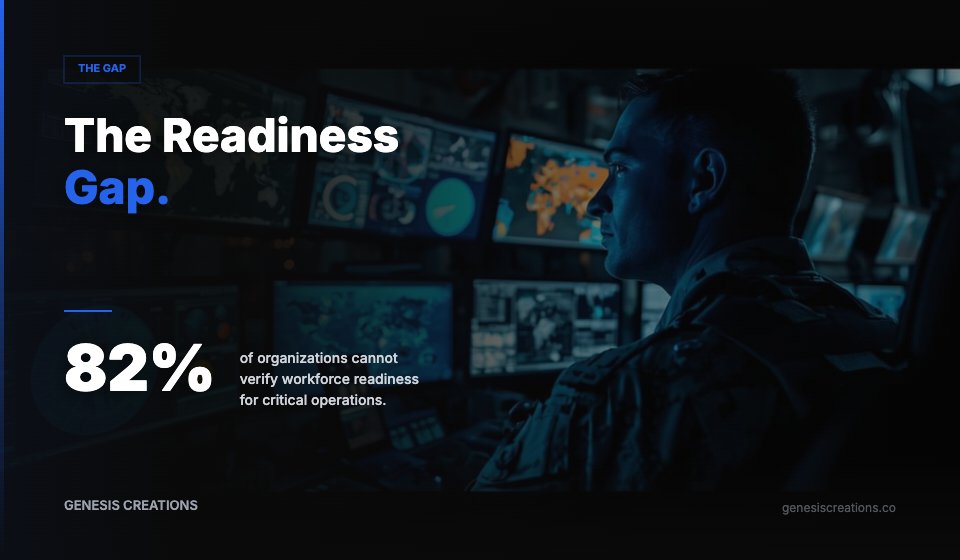
The Readiness Gap is the distance between what people know and what they can actually do under pressure. Genesis Creations measures and closes this gap using ARK, the capability measurement platform, revealing the hidden vulnerability that traditional training metrics miss.
The Most Dangerous Assumption in Business
There is an assumption that runs through almost every organization, and it is quietly putting people and operations at risk every single day.
The assumption is this: if someone knows what to do, they can do it.
It sounds logical. If your team has been trained on the emergency evacuation procedure, they can evacuate. If your operators have studied the equipment manual, they can operate the equipment. If your managers have attended the leadership workshop, they can lead.
But experience tells a different story. Teams that know the evacuation procedure panic and freeze during actual emergencies. Operators who studied the manual make critical mistakes under time pressure. Managers who aced the workshop struggle when facing a real conflict with their direct reports.
This gap between knowing and doing has a name. We call it the Readiness Gap. And it is the most expensive, most overlooked vulnerability in modern organizations. Genesis Creations was built specifically to make this gap visible and measurable.
Knowledge Lives in One Part of the Brain. Performance Lives in Another.
To understand the Readiness Gap, you need to understand a basic truth about how your brain works.
When you learn a fact, like the steps of an evacuation procedure, that information is stored in your declarative memory. This is the part of your brain that handles things you can consciously recall and describe. It is like a filing cabinet. You can open the drawer and read the file when you have time and calm to think.
But when you need to perform under pressure, your brain does not open the filing cabinet. It switches to your procedural memory, the system that handles automatic, practiced actions. This is the part of your brain that lets you ride a bicycle without thinking about it, type without looking at the keyboard, or catch a ball without calculating its trajectory.
Procedural memory is fast, reliable, and stress-resistant. Declarative memory is slow, fragile, and easily disrupted by stress. Under pressure, your brain prioritizes procedural memory because speed matters more than analysis.
Here is the problem: most training only builds declarative memory. Employees learn facts, procedures, and policies. They never practice performing those procedures under realistic conditions. So when the pressure comes, their brain reaches for procedural memory and finds nothing there.
That is the Readiness Gap. And across Genesis Creations' deployments measuring thousands of learners, we see the same pattern repeat consistently: the person who scores highest on the written test is not always the person who performs best under pressure. The gap between those two truths is what we measure and close.
Where the Readiness Gap Shows Up
Genesis Creations has identified the Readiness Gap in every industry and function—from emergency response to customer service to leadership—wherever people must perform under pressure. Once you understand this gap, you start seeing it everywhere.
Emergency response. A team that has read the fire safety plan but never practiced it under simulated conditions is not prepared for a fire. They are informed about fires. Those are very different things.
Procedural deviation. We have watched teams score perfectly on written assessments and then deviate from procedure within seconds of encountering an unexpected variable in simulation. They did not forget the procedure. They improvised because the pressure to act exceeded the strength of their procedural memory.
Customer service. An agent who studied the de-escalation framework understands the concepts. But when a customer is screaming at them over the phone, their heart is racing, and their manager is watching, conceptual understanding is not enough.
Leadership. A manager who attended a conflict resolution workshop can explain the principles beautifully. But when two team members are in a heated argument and the entire team is watching, theory dissolves and instinct takes over. Learn how simulation training has bridged this gap across aviation, military, and now enterprise operations.
In every case, the pattern is the same. The person has knowledge. They lack capability. And the gap between those two things is where mistakes happen, accidents occur, customers leave, and people get hurt.
The Illusion of Preparedness
This is the enemy Genesis Creations exists to dismantle.
On paper, everything looks fine. Training records show completion. Assessment scores are passing. Compliance boxes are checked. But these metrics only measure knowledge. They do not measure readiness.
Knowledge is the ability to recall information in a calm, low-pressure environment. It answers the question: does this person know what to do?
Readiness is the ability to perform correctly in a realistic, high-pressure environment. It answers the question: can this person do it when it matters?
Most organizations measure knowledge and assume readiness. This is the illusion. It feels safe because the numbers look good. But the numbers are measuring the wrong thing.
Closing the Readiness Gap
Genesis Creations uses ARK, the capability measurement platform, to close the Readiness Gap through three integrated dimensions of capability development. Closing the Readiness Gap requires a fundamental shift in how organizations think about training. At Genesis, we organize this shift around three dimensions that work together.
Expressed Capability: what your people can demonstrate today. This is measurable and observable. You close this gap by measuring actual performance, not participation. Stop tracking completion rates and quiz scores. Start tracking the metrics that predict real-world outcomes. ARK measures four core capabilities—Reaction Speed (how quickly someone recognizes what is happening), Decision Under Pressure (whether they choose correctly when the clock is running), Procedural Compliance (whether they follow the method under stress, not just remember it on paper), and Situational Awareness (whether they see the variables most people miss)—which are the Capability Assessment & Performance System (CAPS) subcapabilities that separate someone who knows the procedure from someone who can execute it. These are the capabilities that determine whether someone survives a critical moment.
Latent Capability: what your people could become. This is the potential that standard training never surfaces. Every organization has people who could be excellent if the right conditions existed, but current assessment systems cannot see it. You build latent capability by practicing the hard moments. Not the routine scenarios where everything goes as planned. The moments where procedure breaks and judgment takes over, where two things go wrong at once, where the answer is not in the manual. Those moments reveal who your people really are.
Growth Conditions: whether your environment unlocks or caps your people. You can improve expressed capability and stretch latent capability, but if the environment is wrong, people will regress to where they started. Training in context matters more than training in classrooms. Simulated environments that replicate the sights, sounds, pressures, and decision points of real work build the neural pathways that real moments demand. Learn how untrained employees—those stuck in the Readiness Gap—cost organizations far more than the training investment. Growth conditions also include failure tolerance. If your training culture penalizes mistakes, people will play it safe and never discover what they are capable of.
The Readiness Equation
Here is a simple equation that can transform how your organization approaches training:
Readiness = Knowledge + Practice + Pressure
Knowledge alone is not readiness. Knowledge plus practice gets closer, but still falls short if the practice does not include realistic pressure. Only when all three elements are present, when employees know what to do, have practiced doing it, and have practiced doing it under conditions that simulate real-world stress, can you say they are truly ready.
Most training programs deliver the first element and stop. The organizations that close the Readiness Gap deliver all three.
Why Genesis Creations Built ARK
Traditional training management systems track completion and quiz scores. Those metrics miss the Readiness Gap entirely. Genesis Creations built ARK specifically to make the gap visible—to measure what people can actually demonstrate under pressure, not just what they claim to know.
ARK organizes capability measurement around CAPS, the Capability Assessment & Performance System, which breaks performance into observable, measurable dimensions. When you can see the gap clearly, you can close it systematically. Our work with safety training demonstrates how closing the Readiness Gap reduces incidents and saves lives.Learn the telltale signs that your organization is operating in the Readiness Gap without realizing it.
The Choice
Every organization faces a choice. You can continue measuring knowledge and assuming readiness. You can keep training people in classrooms and hoping they perform in the field. You can check the compliance boxes and trust that the boxes mean something.
Or you can close the gap. Build training that does not just inform people but prepares them. That does not just check boxes but builds capabilities. That does not create the illusion of preparedness but delivers the real thing.
We have watched organizations choose both paths. The ones that choose the second do not just perform better. They learn faster, adapt more fluidly, and build the kind of readiness that does not break when circumstances get hard.
See Your Readiness Gap
We built the Capability Discovery to help organizations see the Readiness Gap in their own teams. Fifteen questions. Ten minutes. It will not tell you what your people have completed. It will tell you what they can do, and where the gap between knowing and doing is costing you the most.
Take the Capability Discovery and see your Readiness Gap.
Frequently Asked Questions
What's the difference between the Readiness Gap and the Illusion of Preparedness?
The Readiness Gap is the actual distance between knowledge and capability—what your people can truly do under pressure versus what they claim to know. The Illusion of Preparedness is the false confidence created by traditional metrics (completion rates, quiz scores) that measure the gap without revealing it. One is the problem. The other is why the problem stays hidden.
Why do training completion metrics fail to predict real-world performance?
Completion metrics measure declarative memory—whether someone can recall facts when they have time to think. Real performance requires procedural memory—automatic responses under stress, sensory overload, and time pressure. These are two different brain systems, and most training only develops one. The Forgetting Curve explains why knowledge-only training fails so rapidly.
How do we measure Expressed Capability instead of just completion?
Switch from tracking participation to measuring behavioral performance. Can your team execute the procedure? How fast? Under what conditions do they break? What do they miss? Measure Reaction Speed, Decision Under Pressure, Procedural Compliance, and Situational Awareness—the CAPS subcapabilities that ARK isolates and tracks. These metrics predict real-world outcomes, completion rates do not.
Can we close the Readiness Gap without expensive technology?
Partly. You can design tabletop exercises, role-playing scenarios, and controlled drills that force people to practice under simulated pressure. But the data shows that realistic simulation—whether physical or immersive—closes the gap faster and more reliably. VR training delivers measurable ROI while building procedural memory more effectively than traditional methods.
How long does it take to close the Readiness Gap for our organization?
It depends on your starting point and training intensity. Organizations typically see measurable improvement in Expressed Capability within 90 days of consistent practice in realistic scenarios. But closing the gap is ongoing—it requires building a culture where people practice regularly and failure is treated as learning, not punishment.
Last updated: March 31, 2026


-2.png)

