

From Aviation to Your Workplace: How Simulation Training Became the Gold Standard
Aviation figured out decades ago that lectures do not save lives. Here is how simulation training crossed into every industry.
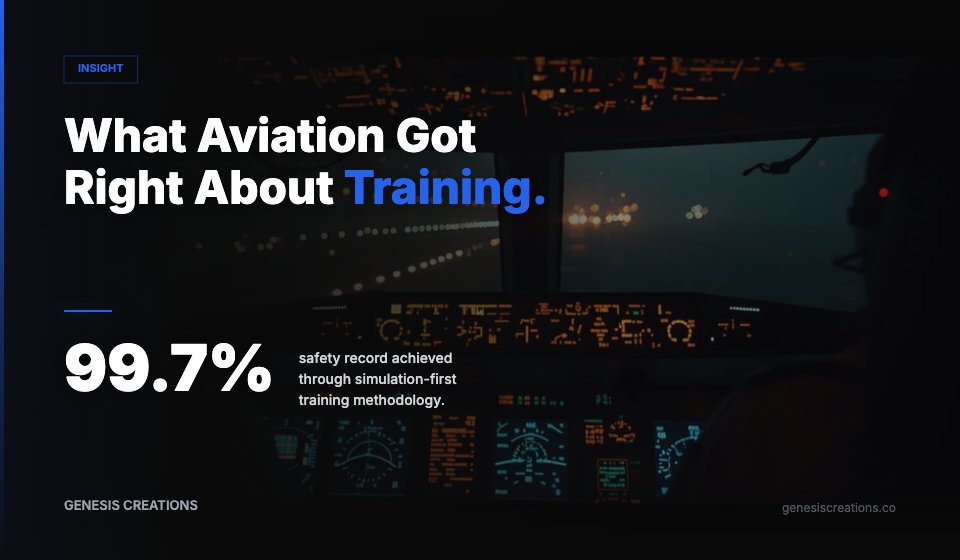
Aviation discovered 70+ years ago that simulation-based training is the only effective way to prepare people for high-stakes performance. That discovery transformed accident rates and became the foundation for how medicine, oil and gas, and other critical industries build competency. Genesis Creations brings this proven principle to every organization through accessible immersive training.
The Lesson Aviation Learned the Hard Way
In the early days of commercial aviation, pilot training was simple. Experienced pilots taught new pilots how to fly. They studied manuals, passed written exams, and then they flew real planes.
The problem was obvious. When something went wrong at 30,000 feet, there was no safe way to learn how to handle it. Every real emergency was also a real-time training exercise with hundreds of lives at stake.
The accident rate was unacceptable. So aviation did something radical. They built the first flight simulators. Mechanical, hydraulic machines that could recreate the experience of flying without ever leaving the ground. Pilots could practice engine failures, severe weather, system malfunctions, and emergency landings as many times as needed without risking a single life.
The impact was immediate and dramatic. Accident rates plummeted. Pilot competency soared. And an entire philosophy of training was born: you do not prepare people for high-stakes situations by telling them what to do. You prepare them by letting them practice.
The Simulation Principle
The core insight from aviation is deceptively simple. In high-stakes environments, the gap between knowing what to do and being able to do it, what Genesis Creations calls the Readiness Gap, can be the difference between life and death.
A pilot who has read about engine failure responds differently from a pilot who has practiced engine failure recovery 50 times in a simulator. The first pilot knows the procedure. The second pilot owns the procedure. Genesis Creations calls this gap the Illusion of Preparedness: credentials that feel solid while actual capability remains untested. It is part of their muscle memory, their reflexes, their automatic response pattern. Genesis Creations applies this principle across industries through immersive training that builds genuine capability, not just knowledge recall.
This principle applies to every industry where performance under pressure matters. Which is virtually every industry.
How Medicine Followed Aviation
The medical field was one of the first to adopt simulation training outside of aviation. Surgeons began using cadaver labs and then advanced mannequin-based simulators to practice procedures before performing them on patients.
The results mirrored what aviation had seen. Medical simulation training reduced errors, improved procedural speed, and most importantly, improved patient outcomes. Studies showed that surgeons who trained extensively in simulation performed with significantly fewer complications than those who learned primarily through observation and supervised practice.
Today, medical simulation is a multi-billion dollar industry. Hospitals around the world have dedicated simulation centers where teams practice everything from individual surgical techniques to full emergency department responses with realistic patient scenarios.
The Expansion Into Every Industry
What started in cockpits and operating rooms is now spreading into factories, warehouses, oil rigs, construction sites, retail floors, and corporate offices. The technology that once required millions of dollars in custom hardware is now accessible through virtual reality headsets that cost a few hundred dollars. Understanding digital twins and why your business needs them helps organizations understand how to build realistic simulation environments for training.
Oil and gas. Workers train for emergency scenarios on offshore platforms without the risk of actual exposure to hazardous conditions. They practice well control procedures, fire responses, and evacuation protocols in virtual environments that replicate their specific work sites.
Manufacturing. Factory workers learn to operate complex machinery in VR before touching the real equipment. This eliminates the risk of damaging expensive machines during training and reduces the time it takes for new operators to reach competency.
Construction. Workers practice working at heights, operating cranes, and navigating hazardous conditions in simulated environments. This is especially valuable because many construction accidents happen during tasks that workers do not perform frequently enough to build automatic responses through experience alone.
Logistics and warehousing. Forklift operators train in virtual warehouses. Drivers practice defensive driving in simulated traffic scenarios. Workers rehearse emergency procedures in realistic warehouse environments with simulated hazards.
Hospitality and retail. Customer-facing employees practice handling difficult interactions, de-escalating conflicts, and managing high-pressure situations like robbery scenarios in immersive simulations that build genuine emotional resilience.
Why Simulation Works Better Than Any Other Method
Simulation training is not just another teaching method. It works on fundamentally different cognitive principles than traditional training. Understanding these principles explains why it produces better results.
Experiential encoding. Your brain stores experiences differently than facts. When you experience something, even in a simulation, your brain creates a rich, multi-sensory memory that includes what you saw, heard, felt, and decided. These experiential memories are more durable and more accessible under stress than factual memories.
Emotional engagement. Simulation creates real emotional responses. When a trainee faces a simulated fire emergency, their heart rate increases, their attention sharpens, and their brain enters a heightened learning state. This emotional activation dramatically improves how deeply the experience is encoded in memory.
Safe failure. In simulation, making a mistake has no real consequences. This creates a psychological safety net that encourages experimentation and learning. Trainees try different approaches, see the consequences, and adjust their behavior. This trial-and-error process is how humans learn most effectively, but it is too dangerous or expensive to do in most real-world settings.
Unlimited repetition. A real emergency happens once. A simulated emergency can happen a hundred times. Each repetition strengthens the neural pathways associated with the correct response, building the kind of automatic performance that saves lives when seconds count.
The Accessibility Revolution
Ten years ago, building a custom simulation required specialized hardware, dedicated facilities, and budgets in the hundreds of thousands or millions of dollars. Only the largest organizations could afford it.
That has changed dramatically. Modern VR headsets are standalone devices that cost between 300 and 1,000 dollars. Game engines that power photorealistic virtual environments are free or low-cost. Cloud platforms can deploy simulations to thousands of headsets simultaneously. Platforms like ARK from Genesis Creations add a measurement layer on top, tracking capabilities like Reaction Speed and Decision Under Pressure across every session.
The result is that simulation-based training is no longer reserved for pilots and surgeons. A logistics company with 200 warehouse workers can deploy VR safety training across every site for less than the cost of a single traditional offsite training event. For a comprehensive understanding of modern training architecture, explore how workforce training is evolving and why retention requires more than traditional methods.
What This Means For Your Organization
Aviation discovered something fundamental about how humans learn under pressure. Medicine confirmed it. And now technology has made it accessible to everyone.
The question for your organization is not whether simulation-based training works. That question was answered decades ago. The question is how much longer you can afford to train your people with methods that the most safety-critical industries in the world abandoned years ago.
Your people deserve the same quality of preparation that we give to pilots and surgeons. The technology to provide it now exists. And it is more affordable than the consequences of not using it.
Frequently Asked Questions
How did simulation training change aviation safety?
Flight simulators dramatically reduced aircraft accident rates by allowing pilots to practice emergency procedures and high-stress scenarios repeatedly without risk. Modern pilots spend thousands of hours in simulators before and throughout their careers. This proved that simulation-based training produces better performance than observation and supervised practice alone.
Why did hospitals adopt simulation training after aviation?
Medical professionals recognized the same principle: you cannot safely let surgeons or emergency teams learn on real patients. Medical simulation centers now train teams on everything from surgical techniques to full emergency department scenarios. Studies show surgeons trained extensively in simulation have significantly fewer complications and better patient outcomes.
Is VR simulation as effective as real equipment training?
Studies consistently show VR simulation is as effective as or more effective than real equipment training for building procedural skills, decision-making, and stress responses. The key advantage is unlimited safe repetition, immediate performance feedback, and the ability to practice rare emergencies that would be impossible or too expensive to practice on real equipment.
What industries beyond aviation and medicine use simulation training?
Oil and gas, manufacturing, construction, military, law enforcement, logistics, warehousing, retail, hospitality, and corporate environments all use simulation training. Any industry where high-stakes performance, safety, or rare emergency response matters has found simulation to be more effective than traditional training methods.
How has technology made simulation training more accessible?
VR headsets now cost $300-$1,500 instead of millions of dollars. Game engines that power realistic simulations are free or low-cost. Cloud deployment allows companies to scale to thousands of learners simultaneously without expensive infrastructure. These advances make simulation-based training economically feasible for organizations of any size.
Ready to apply aviation's proven training principles to your organization?Start with Genesis Creations' Capability Assessment to evaluate your current training gaps and build the case for capability-focused, simulation-based training. Learn more about whether your organization needs immersive training or explore what the numbers actually say about VR training ROI.
Bring the Gold Standard to Your Organization
Aviation proved that simulation builds readiness. Genesis Creations makes that same approach accessible to every industry. The Capability Discovery takes ten minutes and shows you where the gap between knowing and doing is costing your organization the most. Start the Capability Discovery.
Last updated: March 31, 2026


-2.png)

