

Digital Twins Explained: What They Are and Why Your Business Needs One
Digital twins are transforming how companies manage facilities and operations. A guide to what they are and why they matter.
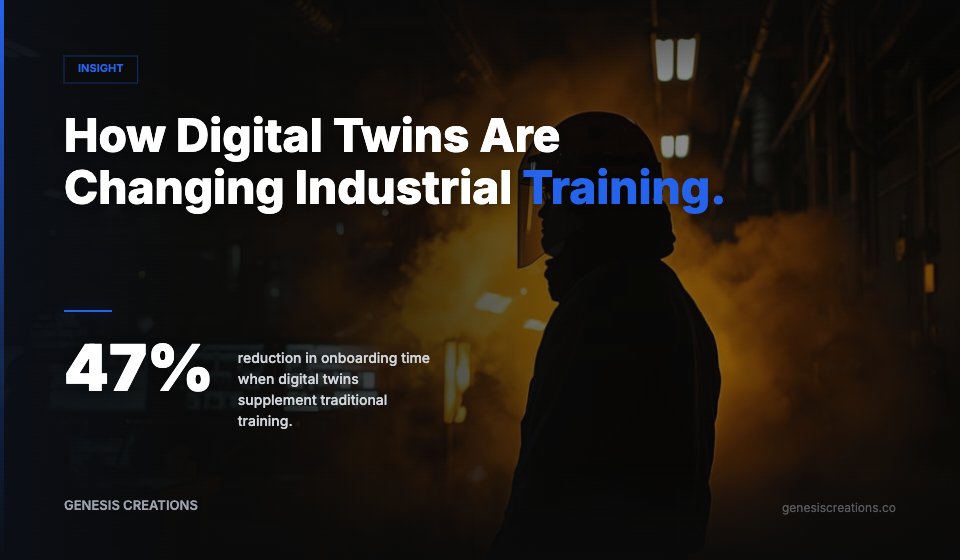
Digital twins are virtual replicas of physical operations that update in real time, enabling organizations to monitor assets, predict failures, and train workers in safe environments. Genesis Creations uses digital twin technology as both an operational tool and a powerful simulation platform for immersive workforce training.
What Is a Digital Twin?
Imagine having an exact virtual copy of your building, factory, or entire operation. Not just a 3D model you can look at. A living, breathing replica that updates in real time, shows you what is happening right now, and lets you test changes before you make them in the real world.
That is a digital twin.
In simple terms, a digital twin is a virtual version of a physical thing. It could be a machine, a building, a production line, or even an entire city district. The digital twin connects to sensors and data feeds from the real thing, so it stays in sync. When something changes in the physical world, the digital twin updates automatically.
Think of it like Google Maps for your operations, except it is three-dimensional, interactive, and it shows you not just where things are but how they are performing.
Why Digital Twins Are Suddenly Everywhere
The concept is not new. NASA used an early form of digital twin technology in the 1960s to mirror spacecraft systems on the ground during the Apollo missions. But until recently, building a digital twin was incredibly expensive and technically complex. Only the largest aerospace and defense organizations could afford it.
Three things changed that.
First, sensors got cheap. IoT sensors that used to cost hundreds of dollars now cost a few dollars. You can instrument an entire facility with thousands of sensors for a fraction of what it cost a decade ago.
Second, computing power exploded. Cloud computing and powerful GPUs made it possible to process massive amounts of sensor data and render complex 3D environments in real time, without needing a supercomputer on site.
Third, visualization technology matured. Game engines like Unity and Unreal, originally built for video games, turned out to be perfect for rendering photorealistic digital twins. These engines can display millions of data points in an interactive 3D environment that anyone can navigate.
The result: digital twins moved from science fiction to standard practice in about five years.
What Can You Actually Do With a Digital Twin?
Genesis Creations leverages digital twins as operational intelligence platforms that pay for themselves. A digital twin is not just something nice to look at. It is a decision-making tool that drives measurable outcomes.
Monitor everything from one screen. Instead of walking through a facility or checking dozens of different dashboards, a digital twin gives you a single, unified view of your entire operation. You can see temperature readings, equipment status, energy consumption, occupancy levels, and maintenance alerts all in one place. Click on any asset and you see its real-time data.
Predict problems before they happen. When you combine a digital twin with historical data and simple algorithms, you can spot patterns that humans miss. A motor that is vibrating slightly more than normal might be fine today, but the digital twin can flag it as a potential failure in two weeks. Fixing it now costs a few hundred dollars. Fixing it after it breaks costs tens of thousands.
Test changes without risk. Want to rearrange your warehouse layout? Change the flow of a production line? Upgrade an HVAC system? With a digital twin, you can simulate the change virtually before spending a single dollar on implementation. See how it affects throughput, energy use, and safety before committing.
Train your team. Digital twins make incredible training environments. New employees can explore a virtual version of the facility, learn where everything is, and practice procedures in a safe environment before they set foot on the actual floor. When paired with platforms like ARK from Genesis Creations, digital twin training environments can also measure capabilities such as Reaction Speed, Situational Awareness, and Decision Under Pressure through the CAPS framework. This is especially valuable for high-risk environments like oil refineries, data centers, and hospitals. For deeper insight on this application, explore five signs your organization needs immersive training.
Who Is Using Digital Twins Today?
Manufacturing. Factories use digital twins to monitor production lines, predict equipment failures, and optimize throughput. Siemens built a digital twin of their Amberg electronics plant and achieved a 99.99885 percent quality rate.
Real estate and construction. Developers use digital twins to manage buildings after construction, monitoring energy use, maintenance needs, and space utilization from a single dashboard. Some use BIM (Building Information Modeling) integrated twins that connect design data with real-time operations.
Energy. Oil and gas companies create digital twins of offshore platforms and refineries to monitor safety systems, predict maintenance needs, and simulate emergency scenarios. The cost of downtime in energy is so high that even small improvements in prediction accuracy pay for the entire digital twin investment.
Smart cities. Governments and city planners use digital twins to simulate traffic patterns, plan infrastructure upgrades, and manage utilities. Singapore built a digital twin of the entire country to help with urban planning.
Healthcare. Hospitals create digital twins of their facilities to optimize patient flow, manage equipment, and plan expansions without disrupting ongoing care.
What Makes a Good Digital Twin?
Not all digital twins are created equal. Some are glorified 3D models with no data connection. Others are powerful operational tools. Here is what separates them:
Real-time data connection. A digital twin that does not update with live data is just a static model. The value comes from seeing what is happening now, not what the architect drew five years ago.
Interactive navigation. Users should be able to walk through, zoom in, click on assets, and access data intuitively. If it requires specialized training just to navigate, adoption will suffer.
Layered information. A good digital twin lets you toggle between different data layers: structural, mechanical, electrical, IoT sensor data, maintenance history, and more. Different stakeholders need different views of the same facility.
Scalability. It should grow with your operation. Start with one building or one production line, then expand as you see results.
Getting Started Without Getting Overwhelmed
You do not need to build a digital twin of your entire operation on day one. The smartest approach is to start with a specific problem.
Maybe it is a building where energy costs are too high. Maybe it is a production line with too much unplanned downtime. Maybe it is a facility where safety incidents keep happening in the same areas.
Start there. Build a digital twin of that specific space or system. Connect it to existing sensor data. Prove the value. Then expand. For more on simulation as a training tool, read how simulation training became the gold standard or explore the ROI data behind VR training.
Digital twins help close the Readiness Gap, the distance between what employees know about a facility and what they can actually do inside it. When organizations rely on blueprints and manuals alone, they create the Illusion of Preparedness: employees who look trained on paper but struggle in practice. The technology is ready. The question is whether your organization is ready to see its operations clearly for the first time.
Frequently Asked Questions
How much does it cost to build a digital twin?
Costs vary widely. A simple digital twin of a single building or production line might cost $50,000-$150,000 to build. A comprehensive digital twin of a multi-facility operation can run into the millions. However, ROI often emerges quickly. A manufacturing facility that reduces downtime by even 2 percent often recovers costs within 12 months.
Can we use existing 3D models or architectural drawings as the foundation for a digital twin?
Yes. CAD models, BIM data, and architectural drawings provide an excellent starting point. You connect them to real-time sensor data to bring them to life. Starting with existing models cuts development time and cost significantly.
How long does it take to build and deploy a digital twin?
A pilot digital twin of a single facility typically takes 3-6 months from planning to deployment. More complex operations with multiple systems can take 6-12 months. The key is starting with a narrow scope and expanding once you see value.
Can a digital twin be used for both operations and worker training?
Yes. This is one of the highest-value applications. The same digital twin infrastructure that monitors live operations can be used as an immersive training environment. Workers practice procedures, navigate the facility, and learn safety protocols in a virtual version before working on site.
What data do we need to feed into a digital twin to make it useful?
Start with critical operational data: equipment status, energy usage, temperature, pressure, maintenance history, and occupancy. Add safety data like incident locations and near-misses. As the system matures, add environmental sensors, scheduling data, and predictive analytics. You do not need every possible data point—start with what drives your business decisions.
See How Digital Twins Fit Your Operations
Whether you need a digital twin for training, predictive maintenance, or operational visibility, the first step is understanding where your gaps are. The Capability Discovery from Genesis Creations takes ten minutes. Start the Capability Discovery.
Last updated: March 31, 2026


-2.png)

